

Bothidae

Kithara's flounder
Laeops kitaharae
FISH SPECIES
Compare fish with laterally compressed, dorsoventrally depressed or asymmetrical body plans across habitats.
01 / NATURAL HISTORY
Flattened body forms represent two distinct evolutionary paths: laterally compressed forms engineered for agility in narrow vertical spaces, and dorsoventrally depressed or asymmetrical forms specialized for living flush against the ocean floor.
02 / LIFESTYLE
Laterally compressed fishes like butterflyfishes and batfishes orient vertically to dart through intricate reef branches, using broad median fins to execute instantaneous, low-radius pivot turns. In stark contrast, depressed rays and asymmetrical flatfishes bury beneath sediment with only elevated eyes exposed, remaining completely motionless until striking passing prey from underneath.
OBSERVATION INDEX
03 / SPECIES
Discover representative species illustrating the ecological diversity, morphologies and adaptations of this group.
Bothidae
Laeops kitaharae
Cyprinidae

Barbodes klapanunggalensis
Melanotaeniidae

Melanotaenia klasioensis
Mugilidae

Planiliza klunzingeri
Labridae

Halichoeres kneri
Labridae

Cymolutes praetextatus
Labridae

Chlorurus oedema
Bothidae

Crossorhombus kobensis
Salmonidae

Oncorhynchus nerka
Acanthuridae

Ctenochaetus strigosus
Mormyridae

Hippopotamyrus paugyi
Nemipteridae
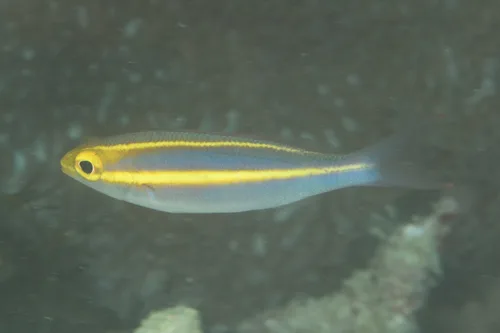
Pentapodus komodoensis
Dorosomatidae

Herklotsichthys koningsbergeri
Albulidae

Albula koreana
Stichaeidae

Dictyosoma tongyeongensis
Stichaeidae

Eulophias koreanus
Gobiidae

Eviota korechika
Sisoridae

Nangra assamensis
Sisoridae

Nangra nangra
Bagridae

Hemibagrus maydelli
Apogonidae

Ostorhinchus wassinki
Labridae

Halichoeres zulu
Pempheridae

Parapriacanthus kwazulu
Labridae

Cirrhilabrus laboutei
04 / FIELD NOTES

A ray is a cartilaginous fish flattened from top to bottom (dorsoventrally depressed) with eyes on top and gill slits on the underside; a flounder is a bony fish that lies on its side, whose eye migrates during larval development to make the body asymmetrical.
A laterally compressed disc shape provides high vertical stability and exceptional turning agility, allowing fish to twist into narrow vertical crevices and maneuver between tangled roots or coral branches without losing control.